Chunk the grid
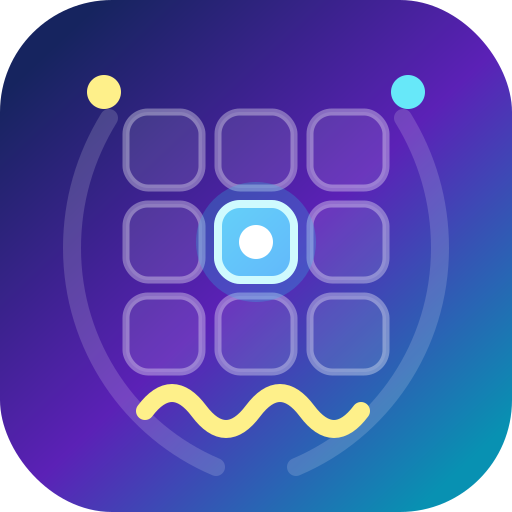
Divide the matrix into top-left, top-right, bottom-left, and bottom-right regions. Remember the count and pattern in each region.
 Matrix Memory
Remember glowing cells across 120 progressive matrix levels with three-second previews, timing, daily puzzles, sound, and account-free friend challenges.
Observe the glowing targets for three seconds, then recall every position after they disappear to train visual and spatial memory.
Level 96 / 120
Start Preview
Divide the matrix into top-left, top-right, bottom-left, and bottom-right regions. Remember the count and pattern in each region.
Group neighboring lights into a line, corner, triangle, or letter instead of treating every position as unrelated information.
After the lights disappear, start with the most certain region and move clockwise or top to bottom to avoid omissions.
Wrong cells count toward the result. Confirm locations before tapping quickly, especially on the larger matrices.
Press Start and watch the target cells glow for three seconds. After they disappear, select every position that was lit. Finding all targets completes the level.
A wrong cell adds one error and flashes red briefly, but it does not end the level or reveal the answer. You can continue recalling the remaining targets.
There are 120 levels across Starter, Explorer, Challenge, and Master stages. The matrix grows from 3×3 to 6×6, while target counts rise within each stage.
No. The three-second preview is fixed for everyone. Timing begins only when the lights disappear and recall starts, keeping results comparable.
The current date creates a fixed level, matrix, and target pattern. Everyone sees the same challenge that day; it changes the next day and requires no account.
Group neighboring lights into lines, corners, or simple shapes. On larger grids, divide the board into four regions and remember each region as a chunk.
No. After finishing, Invite Challenge opens the header share dialog with a URL containing the puzzle seed, time, and errors. Friends replay the identical matrix.
It exercises visual short-term memory, spatial position encoding, attention control, and chunking. Results also depend on device and familiarity and are not a medical diagnosis.